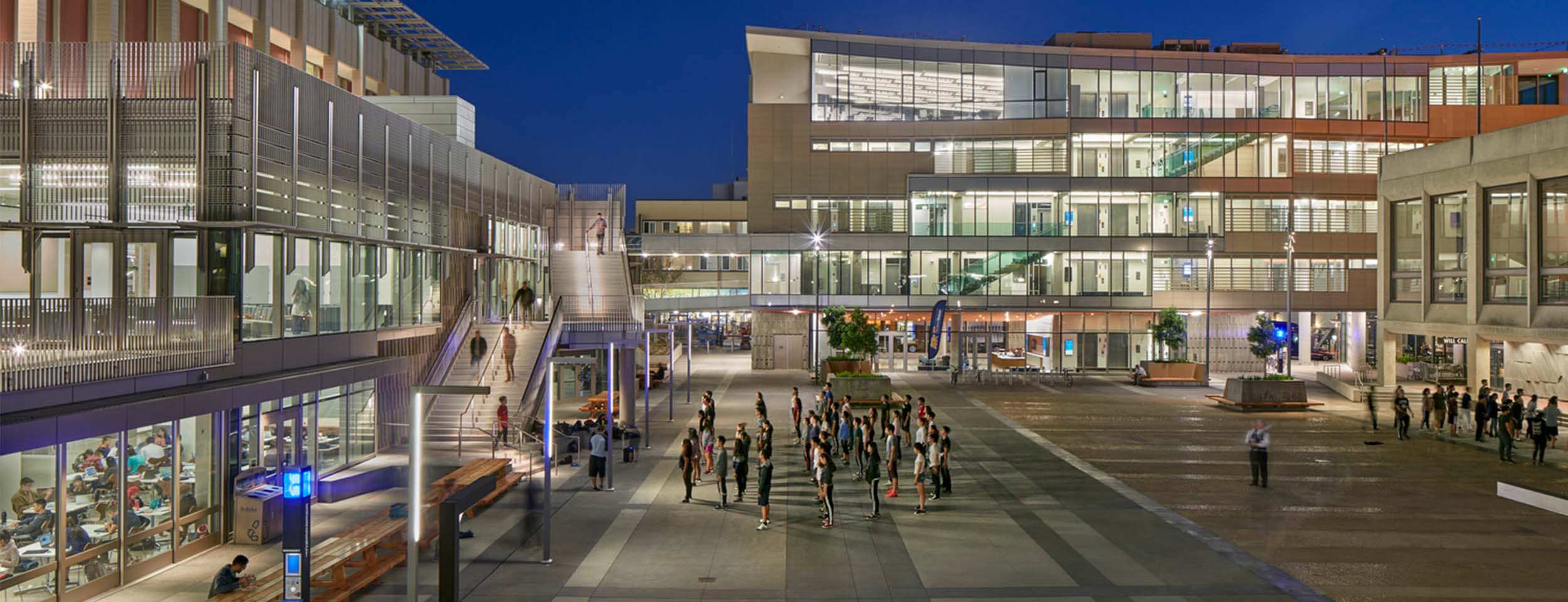
The revitalization of the Lower Sproul Plaza and creation of the new Student Community Center reflect UC Berkeley’s commitment to creating spaces that support gatherings and foster interactions among scholars, faculty, students, and the community.
This multi-building project also reflects the university’s commitment to sustainability. For example, the integrated design process underlying the development of MEP systems produced high levels of energy efficiency and harmony between systems and architecture to create healthy, comfortable, and productive workspaces.
The university desired a minimum of LEED Gold certification, but the team targeted LEED Platinum, with energy goals of 20-30% below Title 24, and better than 40% potable. Our approach addresses internal load reduction; embraces passive systems such as natural ventilation and daylighting; and provides highly efficient lighting, heating, and cooling with associated controls, and an on-site photovoltaic system.
Syska used iterative building performance modeling — including energy simulation, solar shading and daylight modeling, flow network modeling, and computational fluid dynamics of natural ventilation — to “engineer the architecture.” Thus, we were able to optimize building envelope components and the resulting MEP systems that support the primarily passive strategies for this legacy project.