

As part of our innovations program, Syska has been partnering with leaders in artificial intelligence (AI) to investigate the potential of predictive analytics in the AEC Space. Our first task was to address a pesky problem for design teams: construction requests for information (RFIs), which often lead to an enormous amount of wasted time and money.
For an MEP engineer there is no single reason why an RFI occurs on a project. RFIs stem from a complicated, dynamic process of design and an inability to completely describe all the details necessary to construct a project. Causes could include time constraints during design, improper coordination between design specialties, contractor value engineering, owner changes, field conditions, and plain old contractors searching for change orders.
“So what?” you might be thinking. But for design professionals time is money, and time spent on RFIs reduces the profitability of a project. Problems extend to other stakeholders, too. For the construction team an RFI may include scope clarifications that aren’t under contract, thus putting the team at risk for schedule and cost. For the owner RFIs can lead to unanticipated increases in budget and delays in project completion.
As you can see, there are many good reasons to reduce the volume of RFIs. Here’s how we prepared to do just that:
Planning the Approach
We believe that it is inaccurate to use metrics like RFI volume, turnaround time, and total change-order costs as indications of project success or failure. As an alternative, we decided to treat RFI prevention as a quality control / quality assurance activity by learning what is causing RFIs and then adjusting documentation to eliminate the need for them. We identified the goal to use automation to provide guidance and checking of deliverables so the QA / QC is managed, quantitative, and more efficient than traditional checks. The QA / QC process would become a custom checklist of items that are known causes of RFIs.
This custom checklist would be created through data mining and categorization of RFIs from past projects. In the future, we can build in capabilities for automatic checking using API tools applied to project designs.
Next Steps
Our next task was to use machine learning (ML) to categorize RFIs. ML is a subset of artificial intelligence (AI), which is an umbrella term for machine-based intelligence. ML uses algorithms and data to create automation without explicitly defining the steps necessary to create the automation.
The most common uses of ML today relate to internet retail and consumers. Internet retail (and the internet in general) generates a lot of data, and ML is used to automatically create targeted ads and other inducements to purchase goods and services. For example, if you post pictures on Instagram, ML is used to detect that an image is a cat or a dog or your child. This information is then used to customize the ads you see during your browsing experience or when you log on to Amazon. This use of ML – an algorithm to characterize image data, combined with lots of images, resulting in the ability to predict the content of an image, is called a predictive model. The output from a predictive model is a predictive analytic.
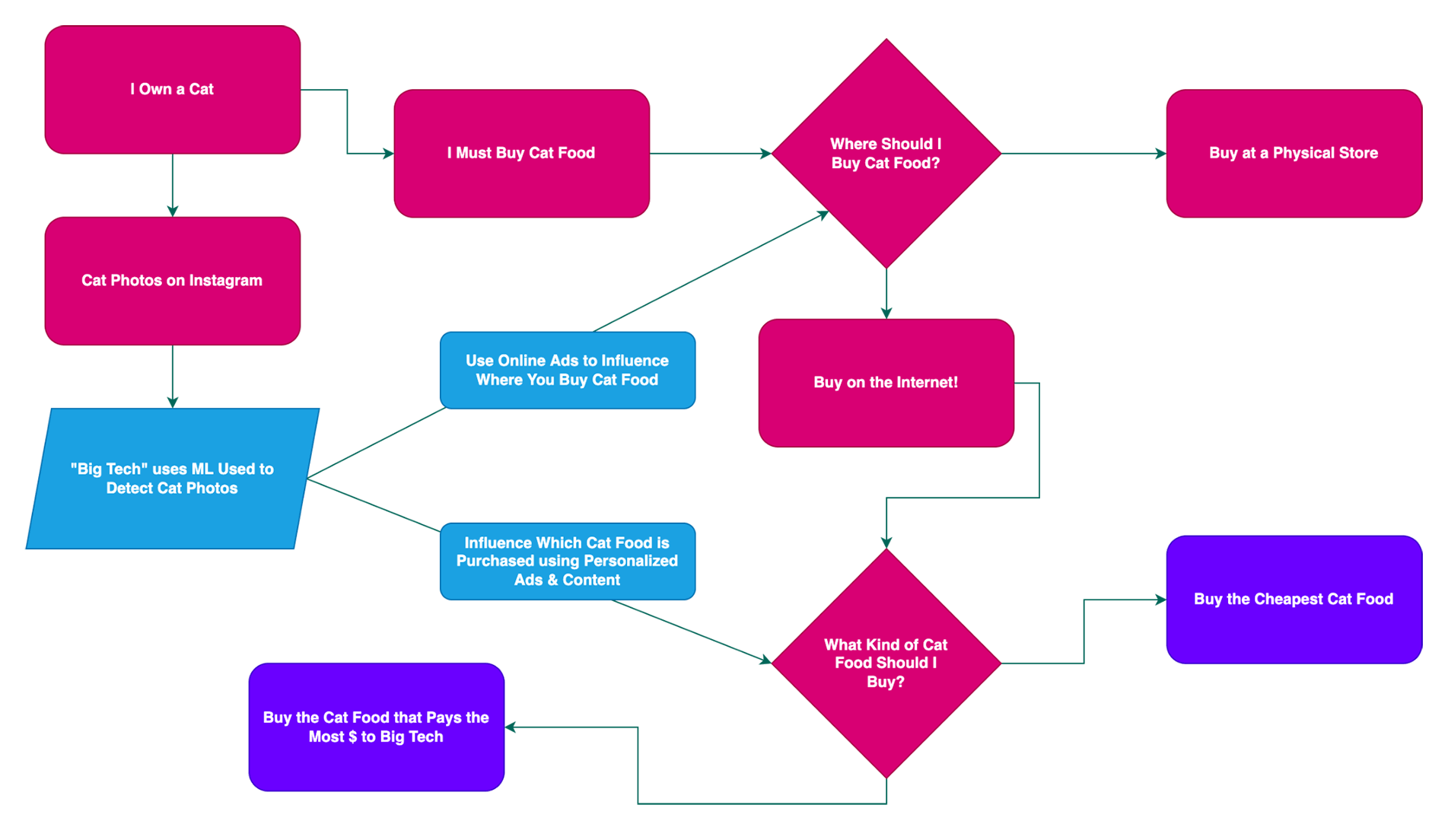
This flowchart shows a basic connection between posting cat photos on social media and machine learning. The content you post on social media is indicative of your lifestyle, what you purchase, and what you find important. This means that the data from social media can be used by advertisers to customize your online experiences. This is a basic connection because this diagram only touches the surface of possible ML-influenced interactions. This entire relationship can also be abstracted and applied to ANY purchase decision on the web by changing the upper three attributes to “I post photos on social media which are indicative of something I must buy.” This is important to understand for design and construction because it explains the motivation to develop ML tools – they influence what we buy on the internet. This means the tools are very sophisticated and powerful, with lots of options for how they can be applied to AEC industry uses. (Source: M2x.ai)
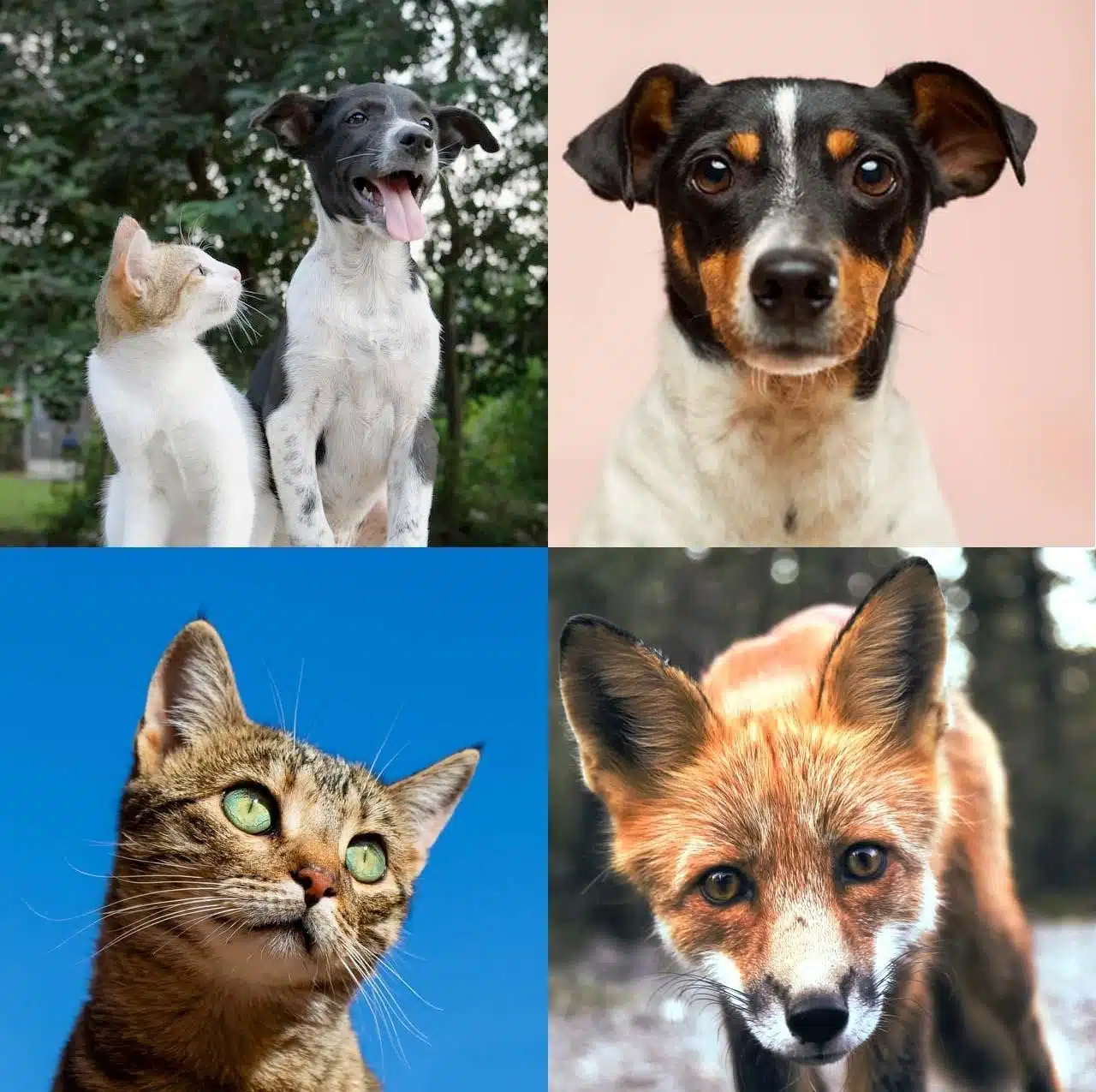
ML tools occur in sets or are “stacked” together, the need for which is demonstrated by these images. If ML was used to create a predictive model that detected whether an animal was either a dog or a cat, it would likely predict that a fox is a cat. Similarly, notice how the eyes on an animal are very distinctive, as shown in the lower left. For example, you could detect a cat based on the shape of its iris and distinguish it from the fox. But if the animal isn’t looking at the camera, such as in the upper left image, the detection would either fail or be incorrect. ML tools are stacked so, for example, a confidence level can be assigned to an image detection or relationships can be detected, e.g., “This is the same cat he posted to Instagram last week.” This is important to understand for design and construction because similar stacks of ML tools are needed to create complex solutions. (Source: images from Unsplash)
As mentioned earlier, our attempts to create a predictive model began with categorization. We employed a process called “segmentation,” where RFIs are grouped into clusters of similar types, tagged by their content. This process involves preparing the data, running analysis tools to filter the data, and then using ML tools to map similarities between RFIs. Once the RFIs were characterized, we established priorities for additional analysis to deepen the correlation between RFIs and their causes. For example, project descriptions and attributes can be used to increase the relevance of a given potential RFI topic. The overall objective is an understanding that leads to the development of targeted tools, which can then be tested and evaluated as risk management and QA / QC tools.
In my next blog I’ll tell you more about this process and the results to date. Spoiler alert: We are making headway toward eliminating those dreaded RFIs. By the end of this initiative we’ll have some good news for design teams to celebrate.